The Argument
For half a century, the search for cognitive enhancers has been a search for louder signals. Piracetam, modafinil, ampakines, and BDNF agonists all operate at the level of neurotransmission, making neurons signal harder. The pharmacology differs but the underlying logic is consistent. None have delivered lasting improvement in learning or memory where cognitive decline is most prevalent. The ceiling is conceptual, not pharmacological.
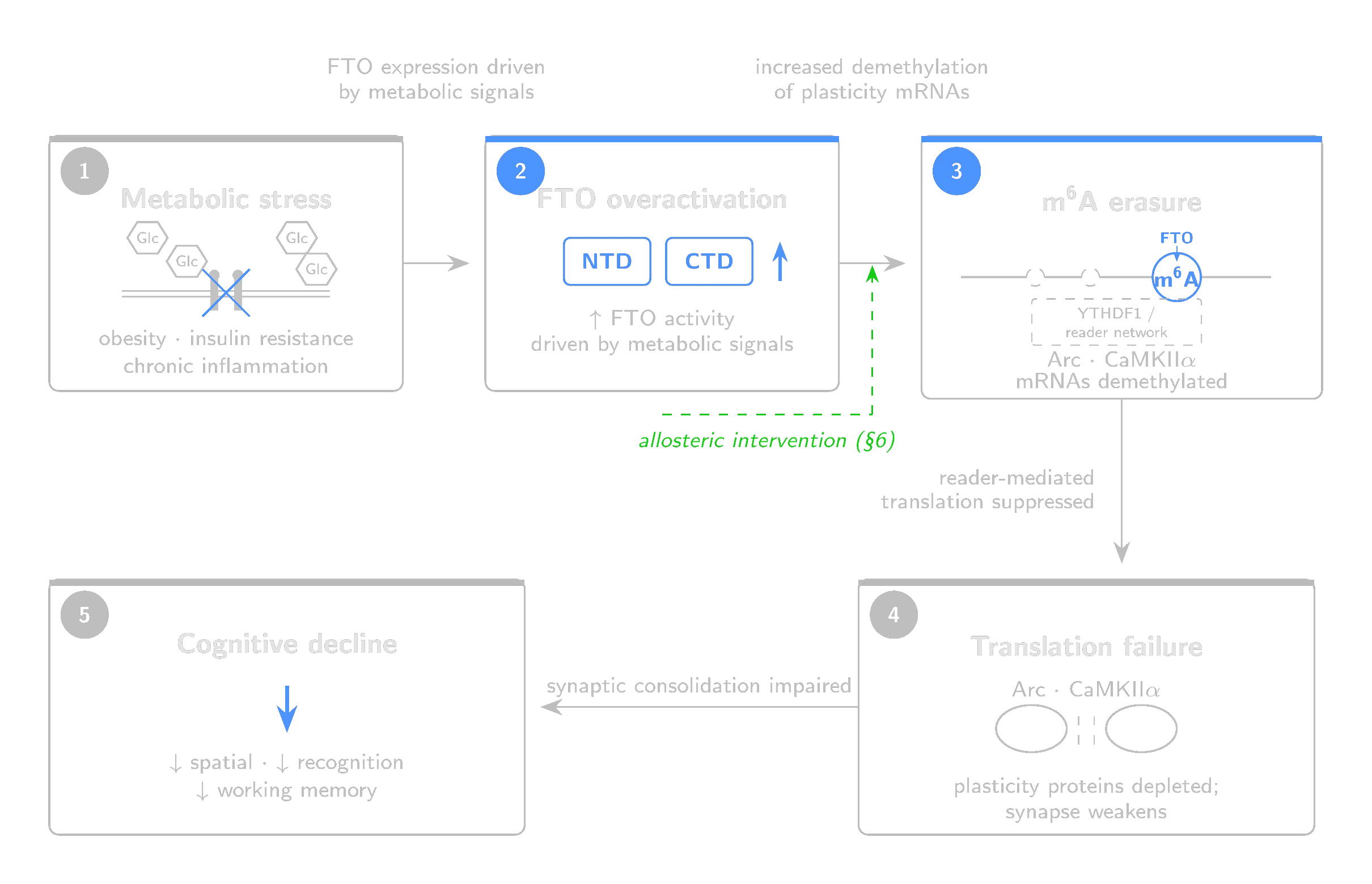
This paper argues the constraint is one layer below neurotransmission. Memory consolidation requires local protein synthesis at activated synapses, and that synthesis is gated by a reversible chemical mark on messenger RNA called m6A. Writer enzymes install the mark, the reader YTHDF1 translates the marked transcript into protein, and the eraser FTO strips it off:
In a healthy brain, writing and erasing cycle with neural activity. Under chronic metabolic stress (obesity, insulin resistance), FTO activity appears to increase and the marks are stripped faster than they are laid down, closing the gate and suppressing plasticity-gene translation.
The Complication
Blocking FTO should fix this, and sometimes it does! FTO inhibition in metabolically stressed mice rescues spatial memory and upregulates plasticity genes. But FTO deficiency also damages neurogenesis, disrupts BDNF processing, and impairs working memory. The broader literature on FTO and cognition is genuinely contradictory.
The paper resolves this through four distinctions. Genetic ablation removes the protein entirely and permanently; a drug that partially inhibits for a few hours is a different perturbation. Complete loss is not partial reduction. When FTO runs at homeostatic levels, the healthy brain is a different system from the metabolically stressed brain, where FTO is pathologically overactive. And outcomes depend on brain region and cognitive task. The refined hypothesis, three testable predictions, and the full reconciliation of conflicting results are in the PDF.
The Proposition
Every reported FTO inhibitor targets the conserved active site. This creates problems the paper addresses in detail: poor selectivity across the AlkB dioxygenase superfamily, binary dose-response approaching full enzymatic shutdown, and competition with abundant endogenous substrates behind the blood-brain barrier.
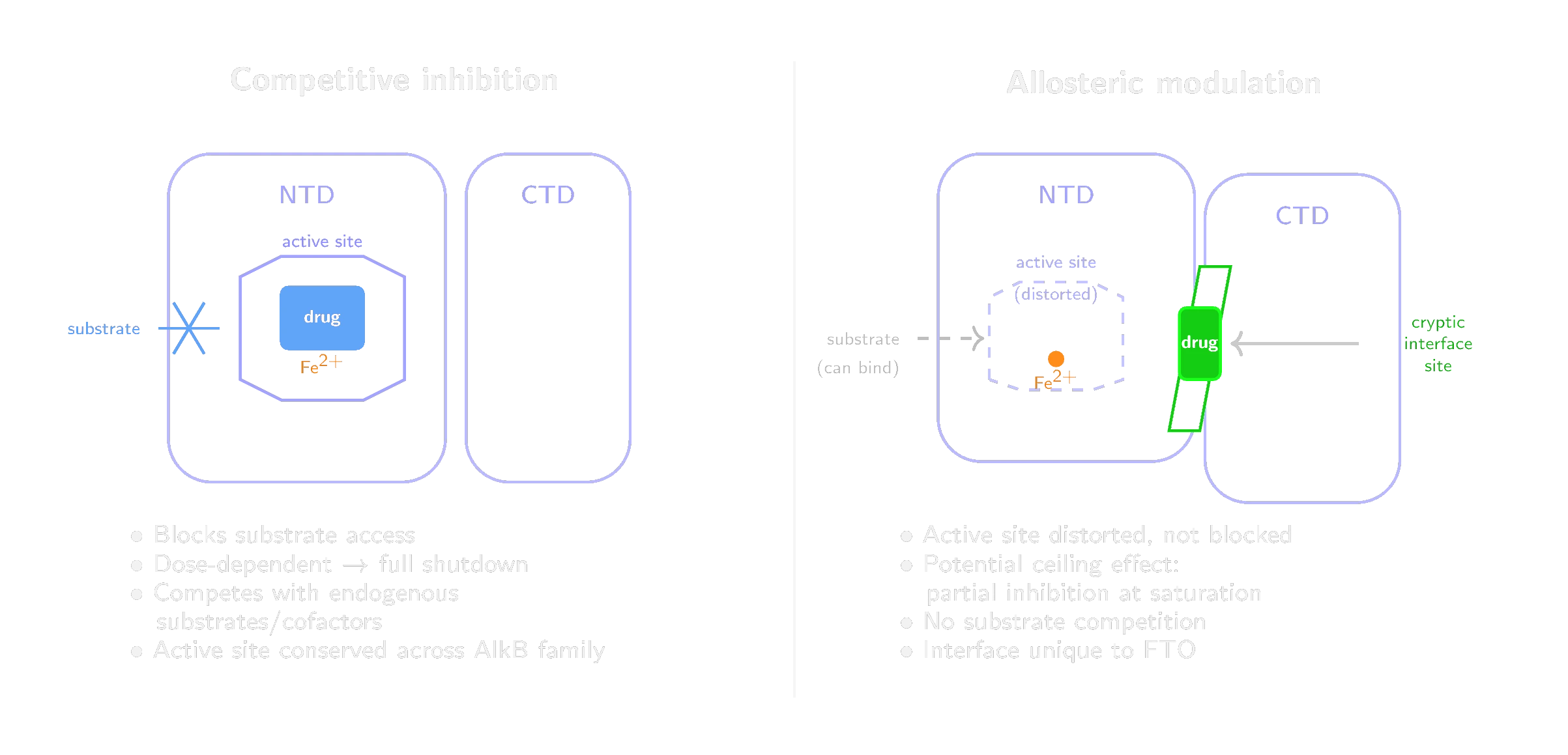
A cryptic site at FTO's NTD-CTD domain interface, revealed by solution NMR and molecular dynamics in 2022, offers a structurally distinct target. The site is unique to FTO, and an allosteric modulator binding there can produce graded inhibition with a ceiling effect in which the enzyme retains partial activity even at saturation. Drag the slider below to see why this matters.
The first noncompetitive FTO inhibitor targeting this site was reported in 2026, with kinetics showing reduced at unchanged . Whether compounds at this site cross the blood-brain barrier and preserve neurogenesis at effective doses remains open. The hypothesis is specific and falsifiable. What remains is the chemistry.
References
- M. A. Sutton and E. M. Schuman. Dendritic protein synthesis, synaptic plasticity, and memory. Cell, 127:49-58, 2006.
- C. Sidrauski, D. Acosta-Alvear, A. Khoutorsky, et al. Pharmacological brake-release of mRNA translation enhances cognitive memory. eLife, 2:e00498, 2013.
- D. Dominissini, S. Moshitch-Moshkovitz, S. Schwartz, et al. Topology of the human and mouse m6A RNA methylomes revealed by m6A-seq. Nature, 485:201-206, 2012.
- G. Zheng, J. A. Dahl, Y. Niu, et al. ALKBH5 is a mammalian RNA demethylase that impacts RNA metabolism and mouse fertility. Molecular Cell, 49:18-29, 2013.
- G. Jia, Y. Fu, X. Zhao, et al. N6-methyladenosine in nuclear RNA is a major substrate of the obesity-associated FTO. Nature Chemical Biology, 7:885-887, 2011.
- X. Wang, B. S. Zhao, I. A. Roundtree, et al. N6-methyladenosine modulates messenger RNA translation efficiency. Cell, 161:1388-1399, 2015.
- H. Shi, X. Zhang, Y.-L. Weng, et al. m6A facilitates hippocampus-dependent learning and memory through YTHDF1. Nature, 563:249-253, 2018.
- Z. Zhang, M. Wang, D. Xie, et al. METTL3-mediated N6-methyladenosine mRNA modification enhances long-term memory consolidation. Cell Research, 28:1050-1061, 2018.
- J. Widagdo, Q.-Y. Zhao, M.-J. Kempen, et al. Experience-dependent accumulation of N6-methyladenosine in the prefrontal cortex is associated with memory processes in mice. Journal of Neuroscience, 36:6771-6777, 2016.
- J. Mauer, X. Luo, A. Blanjoie, et al. Reversible methylation of m6Am in the 5' cap controls mRNA stability. Nature, 541:371-375, 2017.
- B. J. Walters, V. Mercaldo, C. J. Gillon, et al. The role of the RNA demethylase FTO and mRNA methylation in hippocampal memory formation. Neuropsychopharmacology, 42:1502-1510, 2017.
- A. Irisarri, A. Corral, N. Perez-Salvador, et al. FTO inhibition mitigates high-fat diet-induced metabolic disturbances and cognitive decline in SAMP8 mice. Molecular Medicine, 31:73, 2025.
- M. S. Ben-Haim, Y. Pinto, S. Moshitch-Moshkovitz, et al. Dynamic regulation of N6,2'-O-dimethyladenosine (m6Am) in obesity. Nature Communications, 12:7185, 2021.
- A. Spychala and U. Ruther. FTO affects hippocampal function by regulation of BDNF processing. PLoS ONE, 14:e0211937, 2019.
- L. Li, L. Zang, F. Zhang, et al. Fat mass and obesity-associated (FTO) protein regulates adult neurogenesis. Human Molecular Genetics, 26:2398-2411, 2017.
- R. Chang, S. Zhu, J. Peng, et al. The hippocampal FTO-BDNF-TrkB pathway is required for novel object recognition memory reconsolidation in mice. Translational Psychiatry, 13:349, 2023.
- M. Tarullo, G. Fernandez Rodriguez, A. Iaiza, et al. Off-target inhibition of human dihydroorotate dehydrogenase (hDHODH) highlights challenges in the development of FTO inhibitors. ACS Pharmacology and Translational Science, 7(12):4096-4111, 2024.
- B. Khatiwada, T. T. Nguyen, J. A. Purslow, and V. Venditti. Solution structure ensemble of human FTO reveals druggable surface pockets at the interface between the N- and C-terminal domain. Journal of Biological Chemistry, 298(5):101907, 2022.
- A. Singh, F. Pettini, B. Gianibbi, et al. Structure-based discovery of a non-competitive FTO inhibitor bound to a cryptic site at the domain interface. Journal of Molecular Biology, 438(2):169575, 2026.