I went stargazing for the first time in my life yesterday in Itapúa, Paraguay. There's very little light pollution here, so it's excellent. I took a photo with my iPhone and mapped the constellations from it.
It turns out there were five constellations in the frame: Canis Major, Puppis, Carina, Vela, and Pyxis. I had Sirius (HD 48915, mag −1.4) and Canopus (HD 45348, mag −0.7) in the same photo. These are the #1 and #2 brightest stars in the entire night sky.
How I did it
I wanted to try and map out constellations on my own. So I extracted the EXIF tags from the photo: GPS coordinates (27.002°S, 55.682°W), UTC timestamp, and the phone's compass heading (GPSImgDirection, 16.6°, roughly NNE).
I looked up my phone's lens diagonal field of view (around 77°). Now I had the latitude, longitude, time, heading, and FOV. So I computed the approximate celestial coordinates the camera was pointing at: RA ≈ 120°, Dec ≈ −39°, somewhere in the constellation Puppis.
Then I pulled stars from the Hipparcos and Henry Draper catalogs for that sky region, and matched the brightest spots to their geometric configuration against the catalog (asterism matching).
This worked! Now I had the camera's exact pointing and projection. Every cataloged star sits at its true pixel.
A ship in the sky
Something interesting I found about this is that four of the constellations in this photo (Puppis the Stern, Carina the Keel, Vela the Sails, and Pyxis the Compass) used to be a single giant constellation called Argo Navis, the ship of Jason and the Argonauts. It was the largest constellation ever recognized, until French astronomer Nicolas-Louis de Lacaille split it up in 1752 because it was unwieldy.
So four of the constellations in this iPhone photo were once one ancient ship in the sky.
The same patch of sky, in other wavelengths
With those coordinates I could pull the same patch of sky from NASA's public archives in other wavelengths. And so I did.
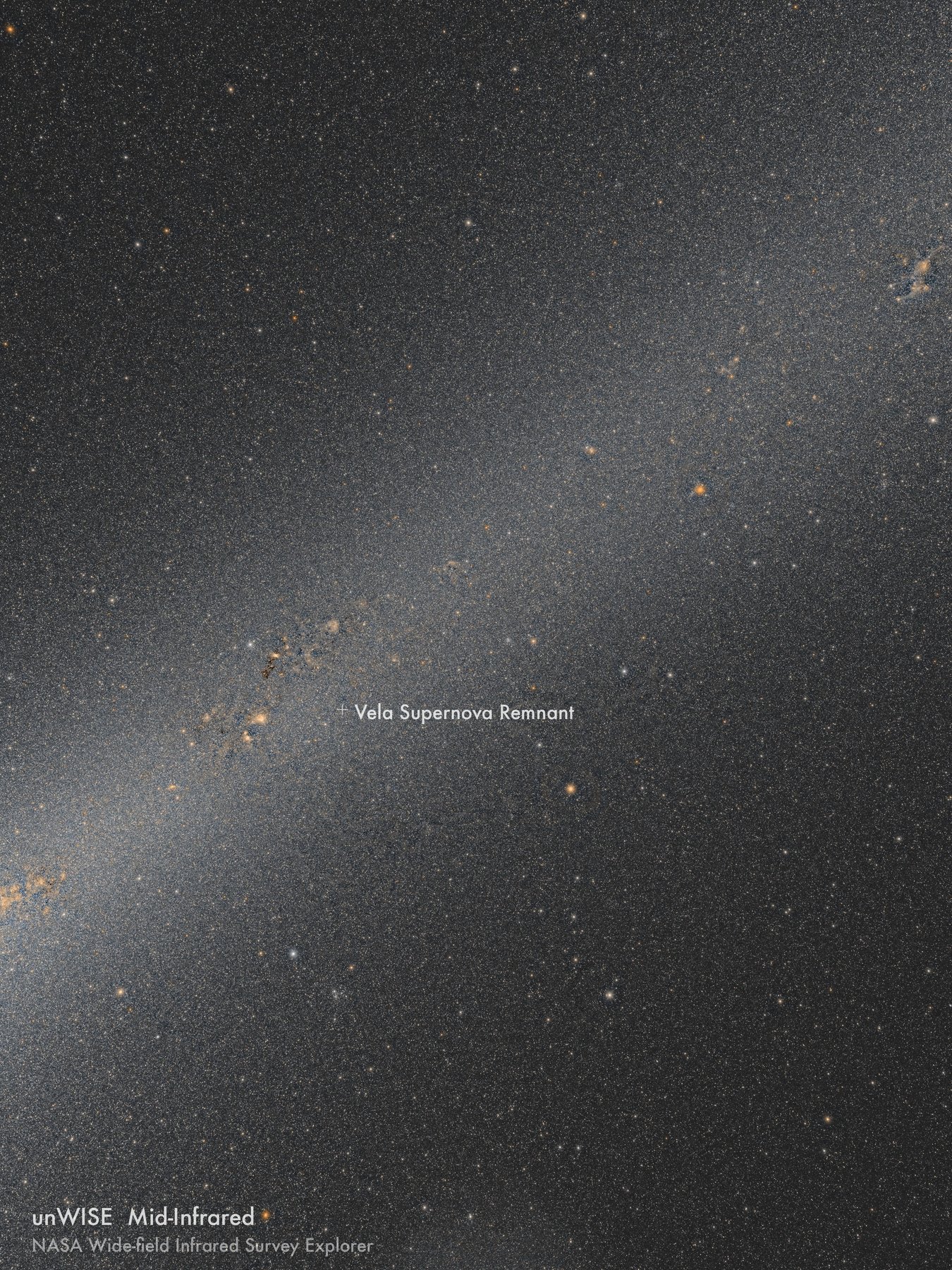
unWISE. A mid-infrared coadd from NASA's WISE mission (Wide-field Infrared Survey Explorer). The diagonal band is the Milky Way's dust disk. This field also contains the Vela Supernova Remnant, from a star that exploded around 11,000 years ago.
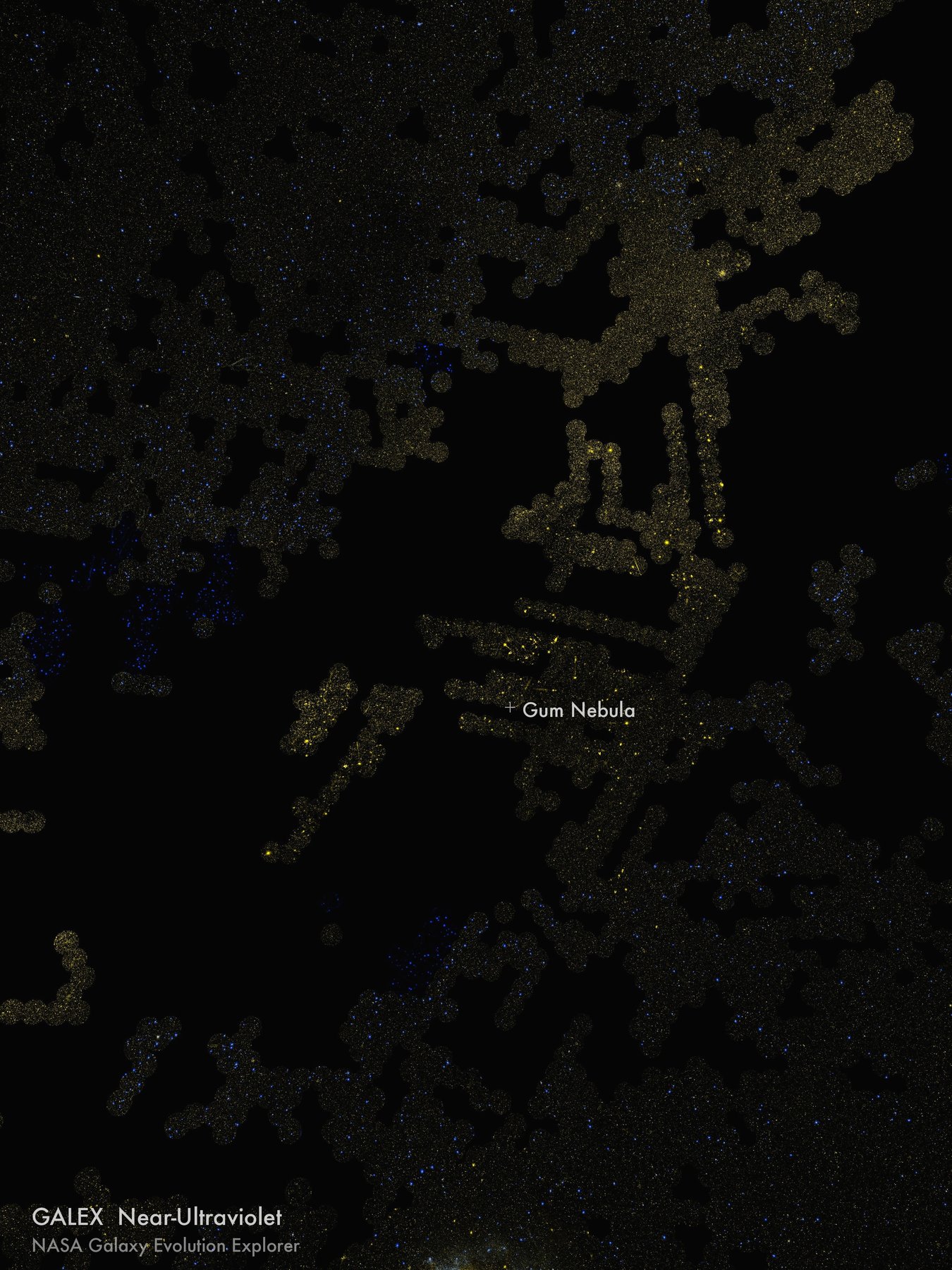
GALEX. An ultraviolet view from NASA's Galaxy Evolution Explorer. The diffuse yellow-gold glow is interstellar gas and dust lit by UV radiation from nearby hot stars. This field also contains the Gum Nebula, one of the largest emission nebulae in the sky.
The math
I also calculated an equatorial grid for the frame. Field of view 56° × 75°, pixel scale 67.4″/px. For reference, the full moon would be only about 27 pixels wide at this scale.
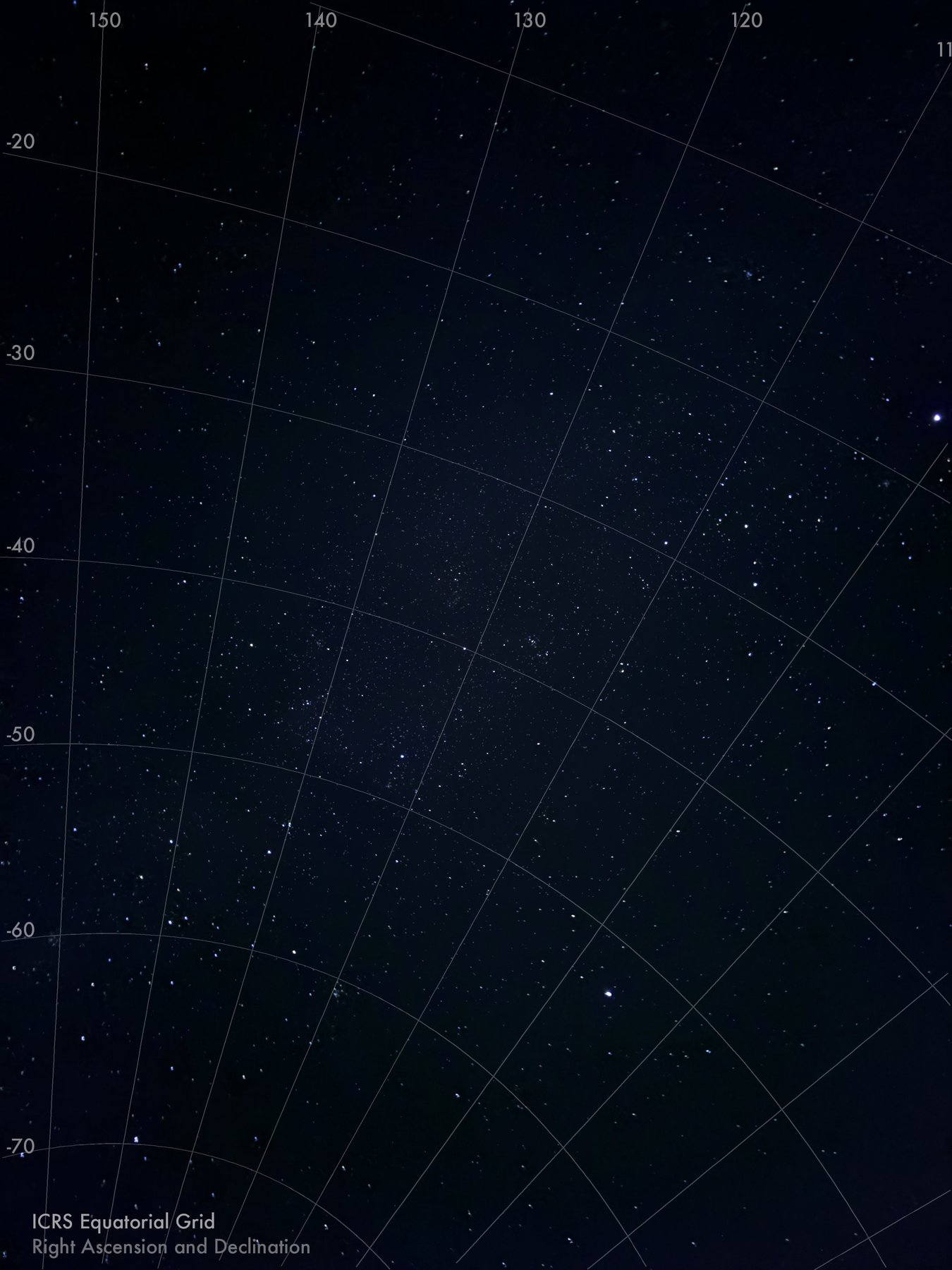
Everything was rendered in Python with astropy for coordinate transforms and catalog queries, and OpenCV for drawing the constellation lines and star glows.
I really feel so inspired. What a beautiful place we live in. :)